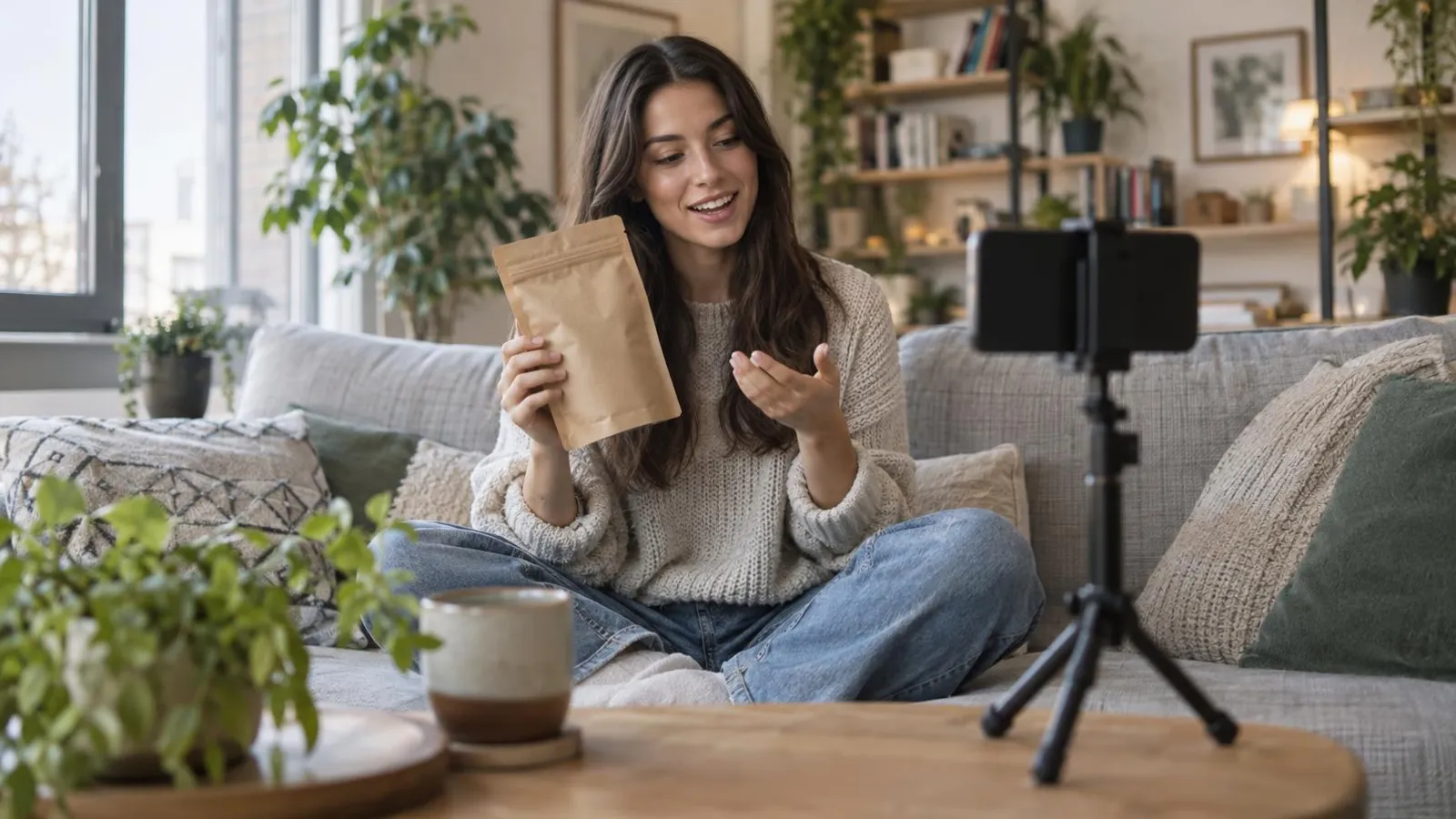
AI UGC ads are short, creator-style videos, someone talking to a phone camera about a product, where the person, the voice or both are generated by AI. They borrow the look of user-generated content (UGC) without filming anyone, which makes them fast and cheap to produce in many versions.
UGC itself means content made by people rather than by the brand. In advertising it now mostly means vertical, phone-shot videos of a person explaining why they use something. Those ads tend to work for small brands because they look like the rest of the feed instead of like an ad, and because a face and a voice explaining a product in plain words earn more trust than a polished banner.
The catch with AI UGC is the line between a presenter and a fake customer. This guide explains what counts as UGC, where AI actors help and where they cross that line, what human creators charge in 2026, which usage rights to ask for, and how to test UGC ads properly.
What is UGC? Two meanings
| Organic UGC | Commissioned UGC (UGC-style ads) | |
|---|---|---|
| Who makes it | Real customers, on their own | Creators you hire, your team, or AI |
| Examples | A Google review, a Story a customer tagged you in, an event photo | "Unboxing my order", "3 reasons I switched to..." |
| Cost | Free, but you need permission to reuse it | Paid per video or per package |
| Control over the message | None | Full, through a brief |
| Where you use it | Reposts, website, social proof | Paid ads, Reels, TikTok |
When marketers talk about "UGC ads" or "a UGC campaign", they almost always mean the second column. AI UGC is a version of that second column in which the creator is synthetic.
Why UGC-style ads work for small brands
- They don't look like ads. On Reels and TikTok a phone-shot video blends into the feed, while a glossy spot with a logo in the first frame gets scrolled past.
- People trust people. Someone explaining in everyday words why they chose a product is more persuasive than a slogan.
- They're cheap per version. Instead of one expensive production you can test several openings and let the results pick the winner.
- They speak the customer's language. A good script describes the problem the way customers describe it, not the way the business describes itself.
UGC isn't magic, though. A UGC-style ad with a weak offer fails like any other ad. The format gets attention; the offer makes the sale.
Where AI UGC helps, and where it doesn't
Good uses for an AI actor:
- Testing ten hooks for an ad before you pay a human creator to film the winner.
- Explaining how a product works, what's in the box and what it costs.
- Producing the same ad in several languages or accents.
- FAQ videos ("Do you deliver on Sundays?") that you'd never film yourself.
Weak spots: hands handling the product, consistent faces across scenes, and emotion. An AI actor can describe a feature well; it struggles to look genuinely delighted while using it.
The red line: an AI actor is not a customer
An AI person can speak for your business. It can't speak as your customer.
| Type of UGC ad | AI actor OK? | Why |
|---|---|---|
| Product demo or how-to | Yes | It's information about the product |
| "3 reasons to try..." from the brand's point of view | Yes | A presenter giving reasons, not a personal story |
| FAQ or offer announcement | Yes | Facts you can stand behind |
| Unboxing | Only as a brand presenter | "Here's what comes in the box", not "I just got mine and I'm obsessed" |
| Testimonial or review | No | Only a real customer can describe a real experience |
| Before and after | No | Results must be real and must be yours |
This isn't only an ethical point. In the U.S., the FTC's rule on consumer reviews and testimonials, in force since October 2024, bans testimonials that misrepresent that they come from someone who doesn't exist or who had no real experience with the product, and the FTC named AI-generated fakes as an example. In the UK, writing or commissioning fake reviews became a banned practice under the DMCC Act from April 6, 2025 (CMA guidance). Other markets have their own consumer protection rules against misleading endorsements.
The platforms add their own layer. TikTok lists AI-generated content as a mandatory ad disclaimer category, and its community guidelines require labels on realistic AI content in organic posts. Meta may require an AI label on photorealistic AI video and realistic AI audio in posts, labels ads made with its own generative tools, and shows a label next to "Sponsored" when an ad includes an AI-generated photorealistic person. The full rundown for Meta, TikTok and YouTube is in AI video ads for small business.
This is general information, not legal advice.
Working with human UGC creators
What they charge. Collabstr, a creator marketplace, reports that in its 2026 data (more than 21,000 collaborations) UGC packages were listed at an average of $180 and actually paid at about $154 after negotiation. Influee's 2026 rate guide gives a typical range of $150 to $212 per video, with beginners around $100 and experienced creators at $500 or more. These are marketplace figures, not an independent survey, so treat them as a ballpark. Some marketplaces suggest adding 30 to 50% for paid-ad usage rights or raw footage.
A good brief covers who the customer is and what bothers them, the one message, what must be shown and what must not be said (especially promises of results), the call to action, the length and format (vertical, 9:16), and how many different hooks you want.
Usage rights are where most small businesses get caught out. Agree on these in writing before filming:
| Item | What to agree |
|---|---|
| Scope | Organic posting only, or paid ads too |
| Duration | 3, 6 or 12 months, or perpetual, and what happens after |
| Channels | Which platforms, plus website, email and WhatsApp |
| Raw footage | Whether you get the files to cut new versions |
| Creator-account ads | Whether you can run ads from their handle (Spark Ads on TikTok, partnership ads on Meta), and for how long |
| Exclusivity | Whether they can film for a direct competitor, and for how long |
| Revisions | How many rounds are included |
Disclosure. When a creator posts sponsored content on their own account, it must be clearly marked as advertising. In the U.S. the FTC's Endorsement Guides require disclosing a material connection such as payment or free product. In the UK, the ASA's influencer guidance asks for a clear label such as "#ad" up front. When you run the video as an ad from your own account, the platform marks it as sponsored.
Sample script: 30-second UGC ad for an online coffee shop
This version works with a real creator who has actually tried the product. The note after it shows how to adapt it for an AI presenter.
| Seconds | On screen | Voice |
|---|---|---|
| 0 to 3 | Creator holds up a coffee bag | "I stopped buying supermarket coffee, and here's why." |
| 3 to 10 | Opens the bag, smells it | "It's roasted the week it ships, and you can tell." |
| 10 to 20 | Makes a cup in the kitchen | "One and a half scoops, and it tastes completely different." |
| 20 to 26 | Close-up of the pack | "They also do a tasting box with three roasts." |
| 26 to 30 | Looks at camera | "Link below. Tell me which one you pick." |
Every claim here (when it's roasted, what's in the box) must be true, and the creator must really have tried it, because the script is a personal experience.
For an AI presenter, drop the first-person story and keep the facts: "Most supermarket coffee was roasted months ago. Ours is roasted the week it ships. Here's how to brew it, and here's the tasting box if you can't decide." Same structure, no pretend customer.
How to test UGC and AI UGC ads
Test against your current best ad: same audience, same budget, same dates. In Ads Manager, watch three numbers:
- Stop rate: 3-second views divided by impressions. This measures the hook.
- Hold rate: average watch time and how many reach the middle and the end.
- Cost per result: cost per message, lead or purchase. This is the one that decides.
Don't judge by likes or by one video. UGC is a volume game: many hooks, few decisions, all based on cost per result. A practical pattern for small budgets is to test hooks with AI versions first, then pay a real creator to film the winning angle, and to use real customers for the testimonial ads only they can make. For the wider picture of where AI saves time in marketing and where it doesn't, see AI marketing for small business.
If you'd rather not juggle tools and creators, PowerAds.ai is an AI marketing agent that works in WhatsApp and a web chat, in English and Hebrew. Describe the product and the angle, and it shows a plan with cost and timing, then produces Reels and TikTok videos, including AI presenter videos, after you approve. Anything that costs money waits for your approval first. How that kind of tool differs from a single video app is explained in what an AI marketing agent is.